Basic Options - What is an option?
In plain English
An option is a reservation ticket: you pay a fee today for the right (not the obligation) to buy or sell shares at a fixed price before a deadline. The fee is yours to lose even if you never use the ticket.
Good fit if
You want to understand what you are looking at on an option chain before spending real money.
Beginner mistake
Thinking "call" means you already own the stock. A call is only the right to buy later — unless you exercise it, you never own shares.
In this options tutorial article, we'll discuss the very basics of Option Contracts. That is,
what is an option? how to trade options? and how do you profit from an option?
Put simply, an option is a contract which you can buy from someone or sell to someone.
Your responsibilities depend on whether you are the one buying or selling.
Now before getting into those responsibilities, lets talk about some important characteristics
of an option contract and then we'll build slowly on an example.
Option Characteristics
- An option contract is based on some underlying stock like IBM.
- An option contract will always have an expiration date.
- An option contract will always have what's called a Strike Price.
- An option contract can be one of two types: Call or Put
Lets talk about each bullet in more detail. I mentioned that an option is simply a contract, but a contract to do what? It is a contract which gives the buyer the right to trade the underlying stock. For a standard equity or ETF option, one contract usually covers 100 shares of that underlying. So buying one IBM call or put typically gives rights tied to 100 shares of IBM. (Corporate actions can create adjusted contracts with different multipliers, and many index options are cash-settled instead of delivering shares.)
The contract will also enforce a time frame to make that trade. Standard monthly equity options typically expire at the close on the third Friday of the expiration month. Many underlyings also list weeklys and other short-dated expirations. The worked example below uses June 2026 IBM prices (mid-June 2026, around when the stock traded near $278). The June monthly options expired at the close on Friday, June 19, 2026.
In addition, the contract will specify a strike price. This is referring to the price of the underlying stock (not the option itself). So to build on our IBM example, you could buy an IBM option for June 2026 where the strike price is $280 and that would give you the right to trade IBM stock at the Strike Price of $280/share.
Call vs Put
But wait, there is something we're still missing. You may be asking yourself, well so what? I have an IBM option for June 2026 where the strike price is $280 and I can trade at that strike price. But do I buy at $280 or sell at $280. That's where another very important characteristic comes into play and that is Call vs Put. If you buy an IBM Call Option, you are given the right to buy 100 shares of IBM at $280/share. If you buy an IBM Put Option, you are given the right to sell 100 shares of IBM at $280/share.So which one do you choose? Call or Put? That depends on your personal belief on how IBM stock will behave. Remember that an option contract has an expiration date. In our example, it is June 19, 2026. So you have to ask yourself,
Since the expiration date is in the future you cannot say with any certainty, but you could make an educated guess. If you think IBM will be above $280/share, you want to buy a Call Option. Why? Because a Call Option will give you the right to buy 100 shares of IBM at $280/share. Now imagine IBM does really well and on June 19, it is trading at $285/share. If you exercise your right, you will buy 100 shares at $280 and sell 100 shares at $285. You've just made a $500 profit. The difference between $285 and $280 multiplied by 100 shares.
Okay, but what if you think IBM will be below $280/share on June 19, 2026? Well then you want to buy a Put Option. Why? Because a Put Option will give you the right to sell 100 shares of IBM at $280/share. Suppose that IBM is trading at $275/share on June 19. Well, if you exercise your right under a Put Option you will buy 100 shares of IBM at $275 and sell 100 shares at $280. Do the math and you've made a $500 profit.
Remember that buying the option contract gives you that right. Which means the person selling you the contract is actually giving you that right. When you exercise the Call Option you are actually buying those 100 shares from that person at the strike price of $280 and selling those same 100 shares on the market at $285. If it were a Put Option, you are buying 100 shares from the market at $275 and selling those 100 shares to that person at the strike price of $280. In both scenarios you are buying low and selling high!
In practice your brokerage handles the share deliveries for equity options. Two terms are easy to mix up:
- Exercise — the option buyer (holder) chooses to use the right to buy or sell the shares at the strike.
- Assignment — the option seller (writer) is obligated to take the other side after a holder exercises.
Option Premium
The one thing we didn't talk about so far is how much does it cost to buy an option contract? That depends on two factors. How close the current market price is to the strike price and how much time is left before the option expires. These two concepts are called Intrinsic Value and Time Value. A Call Option is said to have intrinsic value if the current market price is above the strike price. Generally the price of the option increases by $100 for each $1 increase in the price of the underlying stock above the strike price. The rest of the option price is the Time Value.For example, say the price of the IBM $275 June 2026 contract is $8.40. If the current date is June 5, 2026 you still have two weeks until expiration and the current market price is $278.14. That means approximately $3.14 of the option is intrinsic while $5.26 is the time value. For a Put Option, obviously the Intrinsic Value would be based on how much lower the market price is relative to the strike price.
Time Decay
An important factor to consider is the decay of time. Suppose the price of the IBM stock in our previous example remained at $278.14, but it got closer and closer to June 19. As you approach the expiration date, the Time Value decreases and on June 19, the option will be worth $3.14. I.e., the Time Value is now $0. The Intrinsic Value doesn't decay, just the Time Value. Remember that you bought a June $275 option which means you have the right to buy at $275 and sell at $278.14.Buying and Selling Options
All this discussion was assuming the fact that you would keep the option contract until expiration. But the fact is you may not want to. In reality many people do not buy and hold the option that long. If they see an increase in the option they bought they will most likely sell the option and take their profit.Earlier I mentioned that the cost of the option was dependent on Intrinsic Value and Time Value. Now you know that as time proceeds the decay in Time Value will decrease the value of your option. So the only way to make money is to hope that the underlying stock moves in your favour. Going back to our old example of the IBM June $280 Call option, the option premium (that is, the money you paid to acquire the option) will decrease as you get closer to June 19. But if IBM's market price increases as well, the decay in time value may be offset. How?
Think of it like this; what are the chances that IBM will trade at $280 or better if you have one week to go and the price is already at $279? Now ask yourself what are the chances if the price is currently $265. You can probably guess by now that the closer the market price is to the strike price, the more the option is worth. So if you bought the option for $8.40 when IBM was trading at $278.14 and the next day it went to $281, that option might be worth about $10.10. You could wait until June 19, but if you just wanted to capture a short-term move you can sell and take profit now. In our example, you made a profit of $170. That is ($10.10 - $8.40) * 100.
How to Read Option Chains
NOTE: The first chain screenshot below is from the older Yahoo layout used in the original tutorial. Brokers and Yahoo Finance look different today, but the columns (strikes, bids/asks, volume, open interest) still mean the same things. Jump to Modern Options Symbols (OSI) for how expiration dates appear in today's symbols. You can also open a live IBM chain on Yahoo Finance.Now that you know so much about options, lets talk about how to find them and how to interpret what you see. Lets go with our working example of IBM Call Options. You can look at the diagram below or open Yahoo Finance's options tab for IBM. Classic tutorials showed a table like the one below:
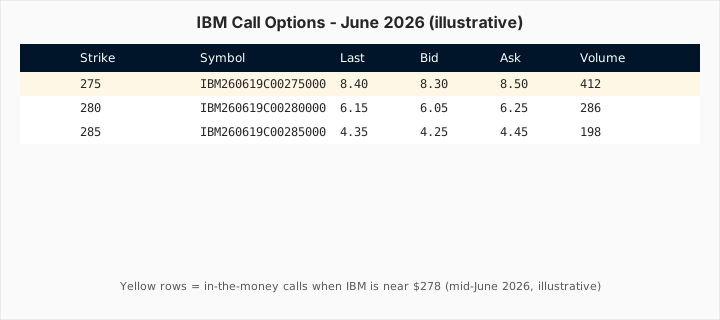
Our IBM $280 June 2026 Call Option is listed here as you can tell by the color coded circles. The red circle indicates this is for June 2026 expiration. The first column shows all the available strike prices. The green circle shows a weird looking symbol. It's certainly not the symbol for IBM, but it looks similar. There is a standard for listing option quotes which you can see by going to the cheat sheet (see link on the right hand navigation).
You can probably figure out the rest of the circles if you've seen stock quotes. A couple of things to point out is the pricing standard and the highted area. Note that it does not list the option as costing $840 or that the price has increased by $1.70. It is divided by 100 and then listed. The volume however, has not been divided by anything! It really is 64. The final thing to note is the area highlighted in yellow. Remember we talked about Intrinsic Value? Well all the options that have Intrinsic Value are highlighted in yellow because the current IBM stock price is $278.14.
Buyer Beware
Until now I've just been giving pure facts about options. Now I'm going to give some advice. You have to be very careful when trading options. People often tout the upside to options investing while playing down the risks involved. If you watch T.V. you'll notice lots of advertisements enticing you to sign up so you can "realize tremendous profits...using leverage". While it is true that you can realize tremendous profits, the chances of you realizing tremendous losses are just as great..if not more. Even the best and brightest investment professionals cannot predict price movement especially over the short term. They get it wrong just as often as they get it right. At the end of the day, options are meant to add another dimension to your entire investment strategy, so be careful not to get wiped out as soon as you enter the option world. It's best to start with a small size—often just one contract—until you understand how premiums, time decay, and liquidity behave. If you find you've made some money doing it, then you can risk more capital carefully.Modern Options Symbols (OSI)
As mentioned above, there is a standard way option symbols are written today (the Options Symbology Initiative, or OSI). You will see a pattern like the one below: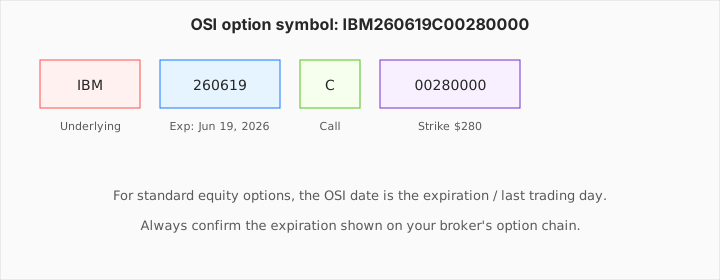
It is mostly self-explanatory. The red circle marks the underlying stock symbol, the blue circle the expiration date (year, month, day), the green circle the type ("C" for Call, "P" for Put), and the black circle the strike price.
For standard PM-settled equity and ETF options, that OSI date is the expiration / last trading day (typically a Friday). You can trade the contract through the close on that date unless your broker or the exchange says otherwise. (Before February 2015, standard equity options effectively stopped trading the Friday before a Saturday expiration date coded in older materials—ignore that "day after" framing for today's chains.) Always confirm the expiration shown on your broker's option chain.
Summary
Okay, we've gone through a lot of material here. And you might still be confused. I suggest you read the material again or at least the parts where you got lost. Then open the Cheat Sheet hub for formulas and definitions, and practice with the Max Loss / Break-Even Calculator before you place a trade.Good Luck! And don't forget to come back soon for any updates or new material I add to this site.