Option Cheat Sheet
Bookmark this page. Use it as your hub while you look at a broker quote: pick a direction, jump to the formula, then run the numbers in the calculator.
Open beside your broker
Need max loss or break-even for a real quote? Use the Max Loss / Break-Even Calculator — then come back here for the definition of the term you forgot.
Profit direction (quick)
| Option | Opening transaction | You generally want |
|---|---|---|
| Call | Buy | price increases  |
| Call | Sell | price decreases  |
| Put | Buy | price decreases |
| Put | Sell | price increases |
Which strategy fits me?
| Your situation | Start with | Then use |
|---|---|---|
| I own shares and would sell at a higher price | Covered Call | Calculator → Covered Call |
| I own shares and want downside insurance | Protective Put | Long Put in the calculator (premium paid) |
| I do not own shares but would buy on a dip | Cash-Secured Put | Calculator → Cash-Secured Put |
| I want defined risk with two strikes, same expiration | Vertical Spread | Bull/Bear call or put spread in the calculator |
| I am still learning calls and puts | Option Basics + Examples | Long Call / Long Put in the calculator |
Max loss & break-even formulas
Premiums are per share. Multiply by 100 (and by contracts) for dollars in your account. Confirm with the calculator.
| Position | Max loss | Break-even (at expiration) | Max gain |
|---|---|---|---|
| Long call | Premium paid | Strike + premium | Unlimited |
| Long put | Premium paid | Strike − premium | Strike − premium (if stock → $0) |
| Cash-secured put | Strike − premium | Strike − premium | Premium received |
| Covered call | Stock can fall (reduced by premium) | Stock cost − premium | (Strike − stock cost) + premium |
| Bull call / bear put (debit) | Net debit | Long strike ± debit | Width − debit |
| Bull put / bear call (credit) | Width − credit | Short strike ± credit | Net credit |
Important Definitions
- Call option - Contract that gives the buyer the right to buy stock from the seller at the low strike price and sell the same stock to the market for the higher market price.
- Put option - Contract that gives the buyer the right to buy the stock from the market at the lower market price and then sell the same stock to the seller at the high strike price.
- Strike Price - The price where the underlying stock would have to be (or better) in order to exercise the option.
- Option Expiration - Stated as the month and year (and on modern chains, the exact date) in which the option expires. Standard monthly equity options typically stop trading at the close on the third Friday of the month. Many underlyings also list weeklys and other non-standard expirations.
- Contract size - A standard equity or ETF option usually represents 100 shares. Adjusted contracts and many index options can differ (indexes are often cash-settled).
- Exercise vs Assignment - The buyer may exercise the right to trade shares at the strike. The seller may be assigned and must take the other side.
- In the money - Term used to describe an option where the market price of the underlying stock is above (for Call Option) or below (for Put Option) the strike price.
- Intrinsic value - That portion of the option premium that correlates to how much it is "in the money".
- Time value - That portion of the option premium that is not Intrinsic Value. The farther away the current date is from the expiration date, the more Time Value you have.
- Net Debit - Type of transaction where you end up paying money to either open or close a position.
- Net Credit - Type of transaction where you receive money to open or close a position.
Option Naming Scheme
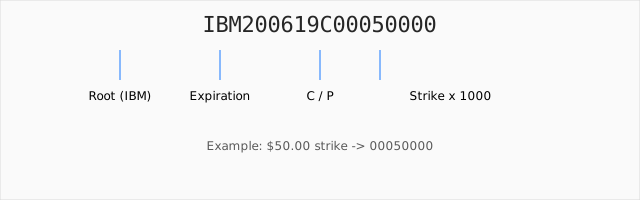
The option naming standards are surprisingly easy to understand. Lets break it down with an example:IBM200619C00050000
Okay lots symbols. But it follows this pattern:
[symbol][Year][Month][Day][Call or Put][strike price]
| Pattern | Description |
|---|---|
| Symbol | The stock symbole. Up to 6 characters if required. Normally 3 to 4. |
| Year | 2 digit format for year. E.g., 20 for 2020. |
| Month | 2 digit format for month. E.g., 01 for January. |
| Day | 2 digit format for the day within the month. |
| Call or Put | C for Call. P for put |
| Strike Price | 8 digits for the strike price. Imagine there is a decimal after the 5th digit. In our example above, '00050000' would be $50. Another example: IBM210115C00110000 would be for strike price $110. |
So in our above above example for IBM200619C00050000, it's shown in our graphic below.